Hopefully Jarre leads the audience into applausing…

For sure, Fiona had pleasure listening…


Hopefully Jarre leads the audience into applausing…


On January 15, 2014, CISAC opened its new Asia-Pacific Regional Office in Beijing at a high profile ceremony that was attended by Chinese officials, CISAC leaders, and representatives from authors' societies across the region.
CISAC successfully opened its new Asia-Pacific Regional Office in Beijing on January 15, 2014. The opening ceremony was attended by 180 guests, including high-level officials from the National Copyright Administration, NPC Legislative Affairs Committee, Supreme People’s Court, China Intellectual Property Society, China Trademark Association and China Copyright Protection Center; Chinese creators from the China Federation of Literary and Art Circles (CFLAC) and other Chinese artist associations; renowned academics; Asian publishers; diplomats; and representatives of nearly all of CISAC’s Asia-Pacific authors’ societies. The opening event was followed by a well-attended seminar on copyright and collective management, organised by CISAC.
The regional office, which had previously operated out of Singapore, coordinates CISAC’s activities in the Asian market and provides significant support to the region’s network of collective management organisations. It is headed by CISAC’s Regional Director for Asia-Pacific, Benjamin Ng.
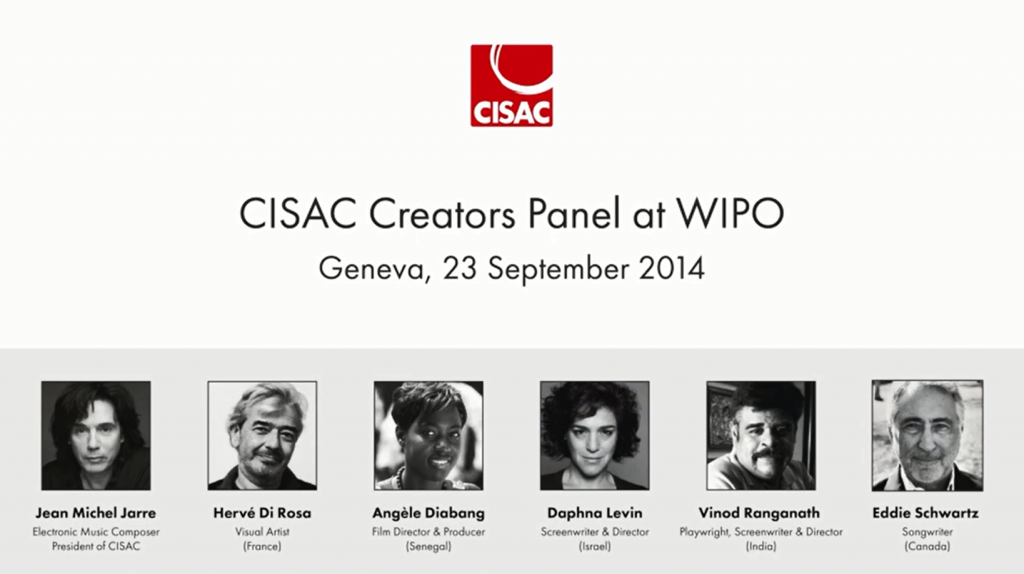
In a keynote address at the opening ceremony, CISAC President Jean Michel Jarre—who was the first Western pop musician to play in post-Mao mainland China — thanked the Chinese government for its support, saying “we are encouraged by the positive collaboration we’ve had thus far and are excited to partner with China as it unlocks the huge potential of its creative economy.”
CISAC’s Director General Olivier Hinnewinkel emphasised in his speech the importance of recognising and protecting creators’ rights in China and across the region. He called the opening of the Beijing Office “the beginning of a new era,” and praised the National Copyright Administration of China (NCAC) as “a valuable partner for CISAC.”
Over 40 journalists from both Chinese and foreign news outlets covered the events, including the major Chinese newspaper, The People’s Daily. Jean Michel Jarre and Olivier Hinnewinkel participated in a dialogue program on national Chinese television CCTV entitled "China's Copyrights Controversy". The 30-minute TV show was broadcasted 4 times in February on CCTV-news. To watch the show, click on the link: http://english.cntv.cn/program/dialogue ... 1068.shtml.

source: http://www.billboard.com/biz/articles/6465776/cisac-2015-global-collections-report-royalties-remain-stable-at-88-billionRoyalties collected by the International Confederation of Societies of Authors and Composers (CISAC) on behalf of songwriters, composers and creators worldwide totalled €7.8 billion ($8.8 billion) in 2013, according to the organization's 2015 Global Collections Report, published today (Feb. 10).
The report analyses worldwide revenues, 87% of which are music-related, collected over 2013 by over 230 societies across 120 territories and representing more than 3 million creators across music, drama, literature and visual arts.
Standout figures include 2.4% growth in performing rights royalties, which crossed the €6 billion ($6.8 billion) barrier for the first time and accounted for 78% of total revenues. A 25% rise in digital royalties also contributed to the €7.8 billion total, which was marginally lower (down 0.8%) than the previous year's figure.
However, CISAC points out that when 2012 revenues are measured at the current Euro rate, excluding the impact of foreign exchange fluctuations, overall royalty collections increased 4.6% year-on-year.
In addition to a spike in digital royalties, contributing factors include a 30% rise in revenues from the BRICS economies, which totalled €365 million ($413 million). Brazil, Russia, India, China and South Africa now generate €1 million ($1.1 million) per day, the report states, although it adds that collections per head of population (€0.12/$0.14 per head) is much lower in the BRICS territories than the world average (€1.30/$1.50).
Latin America and the Caribbean region also reported 17% growth to total €514 million ($582 million), while worldwide audio visual royalties were up 8% on the previous year. However, that growth was offset by a 13% fall in reproduction (mechanical) rights, which totalled €1.4 billion ($1.6 billion), down from €1.6 billion ($1.8 billion) the previous year, and accounted for 18% of all collections.
In line with previous years, Europe remains the largest geographic region for collections, accounting for just over 60% of total royalties with year-on-year growth of 2.3%. The second largest region was Canada-U.S. (16.3%, unchanged from 2012), followed by Asia-Pacific (15.8%), Latin America & Caribbean (6.6%) and Africa (0.7%).
"Overall, the report's findings are very encouraging," Gadi Oron, director general of CISAC tells Billboard. "If you ignore the fluctuation with the exchange rates, we are reporting 4.6% growth, which is quite impressive, especially in light of the economic situation in different markets across the world."
Oron cites the 25% climb in digital royalties as a positive indication of future growth, although concedes the relatively minor year-on-year jump from digital representing 4% of total collections in 2012 to 5% in 2013 means "that there is a lot that can be still be done."
"5% of overall worldwide collections coming from the digital market is good, but it's not good enough," he says. "We want to make sure that our societies generate more from this market and help them with different initiatives in term of lobbying, in terms of support and training and improving their capacities around the world."
Oron's views were echoed by composer and CISAC president Jean Michel Jarre.
"Creators are the singular force behind the works – films, paintings, songs, books, poems, pictures – that millions around the world enjoy. Yet we are often at the mercy of groups that control the channels of distribution of our works," said Jarre in a foreword to the Global Collections Report 2015.
He continued: "This is acutely felt in today's digital ecosystem where creators are the most fragile element. For this reason, we rely heavily on our authors' societies and CISAC to take care of our interests. Alone, we are vulnerable, but when we combine our strengths, via the societies that represent us and protect our works, we have a voice."


Okay, then you do not have to comment...Robi wrote:This is Chinese for me and I don't care at all.
Best reply everKanta wrote:Okay, then you do not have to comment...Robi wrote:This is Chinese for me and I don't care at all.